
NOTE: This article was first published in the Ferndale Historical Society Summer 2013 Newsletter. The museum, and all local newspapers have extensive resources about this case for further study.
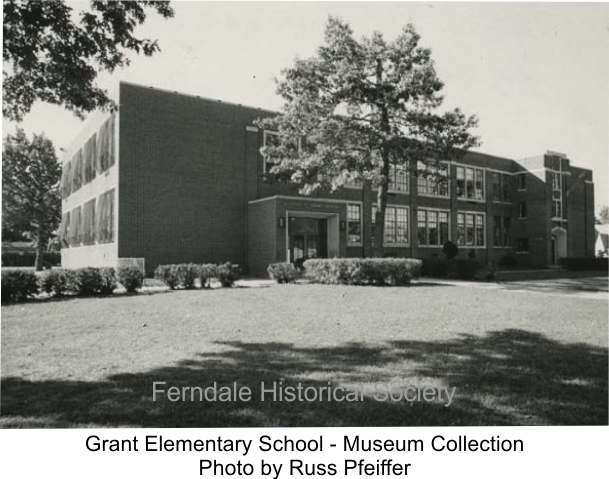
Like many cities in the region and the country, Ferndale has not been immune to racial tensions and controversies over the years. In fact, Ferndale was the first northern school district ever to be found in violation of civil rights laws by the United States Department of Health, Education, and Welfare. The federal government claimed in the late 1960s that the Ferndale School District’s Grant Elementary School, built in Royal Oak Township in 1926, was built as an exclusively African-American school. Over the next decade, litigation ensued, culminating in a federal court’s order in 1980 to integrate Grant with two other schools in the district.
From its earliest days, the Ferndale School District included the predominantly African-American portion of Royal Oak Township near Eight Mile and Wyoming. Several factors reinforced the racial divide between the growing communities of Ferndale and Royal Oak Township during the 1920s, 1930s, and 1940s. The Federal Housing Administration policies limited mortgage funds available to racially integrated neighborhoods. In addition, most of the residential properties in Ferndale contained restrictive covenants forbidding their owners from selling their property to African-American citizens. Oakland County courts routinely enforced those covenants until the United States Supreme Court ruled, in the 1948 decision of Shelley v. Kraemer, that their enforcement was unconstitutional. Homes in Royal Oak Township were not similarly restricted but, as a result, many white families looked elsewhere when deciding where to live.
As the village, and later city, of Ferndale grew during the 1920s, the School District built seven new elementary schools: Harding (1920), Roosevelt (1920), Washington (1923), Wilson (1923), Coolidge (1925), Jefferson (1925), and Grant (1926). In 1925, the Ferndale School District approved a neighborhood schools plan for all the children in the District. Each child would attend an elementary school within one half mile from home.
As part of the neighborhood schools plan, Jefferson opened in 1925 as an integrated school that served both Royal Oak Township and the southwest portion of Ferndale. Jefferson’s attendance for the 1925-26 school year was 297, including 101 African-American children (34%). However, citing turmoil at Jefferson, the School Board authorized Grant as an annex to Jefferson. Grant would not have its own principal. Instead, Jefferson’s principal would continue to oversee Grant.
The Board selected boundaries for Grant that included only African-American neighborhoods (including the Forest Grove and Detroyal subdivisions). Shortly after it opened, Superintendent Edgar Down publicly stated that Grant was the District’s “colored” school and that it was unique in that regard. In fact, it was the only school in the District to employ African-American teachers until 1949, and it did not employ any white teachers or full-time staff until 1952. Additionally, Grant was overcrowded for many years, even while other elementary schools (including Jefferson) had excess capacity. While the District often transferred students from overcrowded schools to balance the size of its classes, the District did not move Grant students to nearby schools for fear of the “turmoil” that would result, according to Superintendent Down.
Of course, the “separate but equal” doctrine then in force allowed school districts to maintain separate facilities for white students and for African-American students. Nevertheless, even after Brown v. Board of Education (1954) ruled that separate schools were inherently unequal, the District maintained neighborhood boundary lines that resulted in the continued segregation of Grant.
Ferndale officials and residents defended the neighborhood elementary school plan and opposed federal intervention, noting that the junior and senior high schools were fully integrated. The School Board stated that Grant Elementary School “was—like other schools built at that time—a logically placed neighborhood school with attendance boundaries drawn solely to create a convenient and compact neighborhood unit.” William Morgan, an African-American member of the School Board, pointed to Grant with pride that “several prominent businessmen and professional people [had] come out of that school” and that it “has become a cultural site in our community.” Morgan’s neighbor, Ernest Wilson, as chairman of the Equal Opportunity in Education committee, sought to improve Grant without necessarily abandoning the neighborhood school plan: “The reason there are objections [to redrawing school boundaries] isn’t racially oriented. It’s because Grant school is known as a school that has below-par educational opportunities.” But, Wilson noted, redrawing school boundaries would also have a palliative effect on race relations, because “having black and white children in grade school together [would] perhaps begin curbing the animosity that seems to grow with age.”
As a result, Wilson asked the United States Department of Health, Education, and Welfare to investigate the Ferndale School District for violations of the 1964 Civil Rights Act. Under the leadership of 31-year-old civil rights director Leon Panetta (the future Secretary of Defense), the Department of Health, Education, and Welfare sought to terminate the Ferndale Schools’ federal funds for the district’s violation of the Civil Rights Act. The District thus became the first northern school district to be cited for segregation in violation of the 1964 Civil Rights Act. Superintendent John Houghton denied “any . . . deliberate attempt to segregate students racially at any school.” Rather, the School Board’s position was that no school in Ferndale was formally segregated by law or policy, only “that Grant School is segregated ‘de facto’ – by neighborhood.”
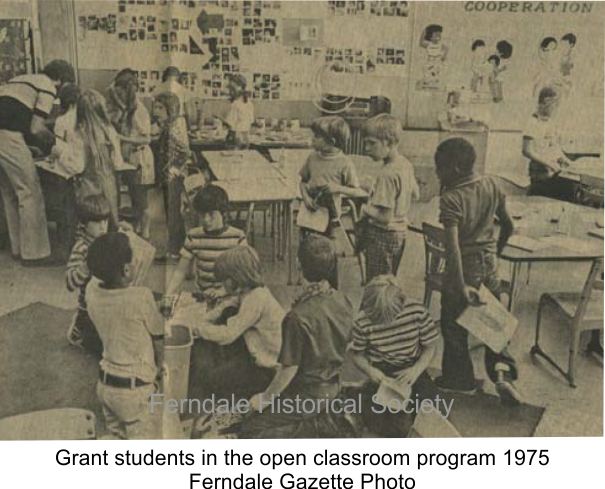
Even while the litigation ensued, between 1968 and 1974, no white children attended Grant, and very few black children attended an elementary school other than Grant. (For example, during the 1974-75 school year, only 15 of the District’s 277 black elementary school students attended a school other than Grant.) Before the 1975-76 school years, however, the School Board allowed the children residing in the Grant neighborhood to attend any elementary school in the District. The Board also created an open classroom program, allowing students from other elementary schools to attend this special program at Grant that offered more individualized treatment of students in a more flexible learning environment. While 31 black students joined 169 white students for the first year of the open classroom, the remaining 230 black students at Grant remained apart from the white students at the school.
Nevertheless, by the time the District implemented these measures in 1975, the United States Justice Department was already seeking a court order to integrate the Ferndale School District, and the Justice Department’s position was that these measures at Grant were not sufficient to integrate the district. In 1980, Judge George Edwards of the Sixth Circuit Court of Appeals (the former police commissioner of the City of Detroit) wrote the final opinion on appeal in the case. His opinion stated that the Ferndale School District retained “vestiges of state-imposed segregation” and that Grant had been intentionally operated as a segregated school even after Brown v. Board of Education held that segregated schools were unconstitutional. In enforcing this decision, the federal district court in Detroit ordered Grant to be integrated with two other elementary schools in the District. It was only in 1995 that the federal court formally lifted federal monitoring of the school district.
The idea that children should attend schools close to home is not itself controversial. But when that concept was combined with decades of housing inequalities to result in neighborhoods that are themselves segregated by race (and school boundaries that were not redrawn to incorporate diverse neighborhoods), the federal government intervened to ensure equal opportunities for all residents in the District. The Ferndale of today is a welcoming, diverse, inclusive community, but to maintain it as such, it is important to remember the times in our community’s history when we have fallen short of this ideal.
SEE ALSO: Grant School Historic Plaque HERE Legal Case Law HERE |
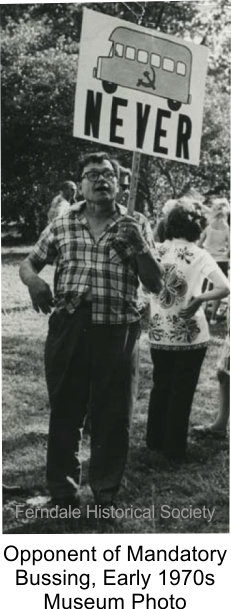 Ferndale was not the only community to be embroiled in litigation over public school segregation. While litigation over Grant ensued, the NAACP filed a lawsuit against the State of Michigan to desegregate Detroit-area public schools. In 1972, federal judge Stephen Roth ruled that 53 school districts in the metropolitan Detroit area would be grouped into 15 clusters, within which students would be bused to achieve a racial balance. L. Brooks Patterson, an attorney and spokesman for opponents of mandated busing, called Judge Roth’s decision “a forced experiment in social engineering” and noted that it was “as incendiary as you can get.” Ultimately, the United States Supreme Court rejected Judge Roth’s solution and ruled that individual school districts could not be ordered to bus students across district lines unless they deliberately engaged in segregation.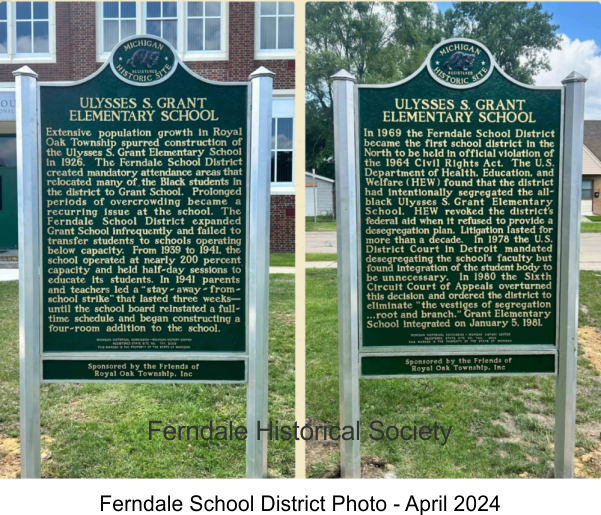


Unauthorized use or duplication of this material without expressed
and written consent from the Ferndale Historical Society is prohibited.
If you have comments, changes, or corrections about this topic
please email info@ferndalehistoricalsociety.org attention Gregg.
Revised: Feb 10, 2026